
3 Mining Pools Captured Nearly 30% of Bitcoin Blocks Since Launch


Key Takeaways
- Unknown miners hold 230,770 bitcoin blocks, 24.03% of all blocks, per Cloverpool data.
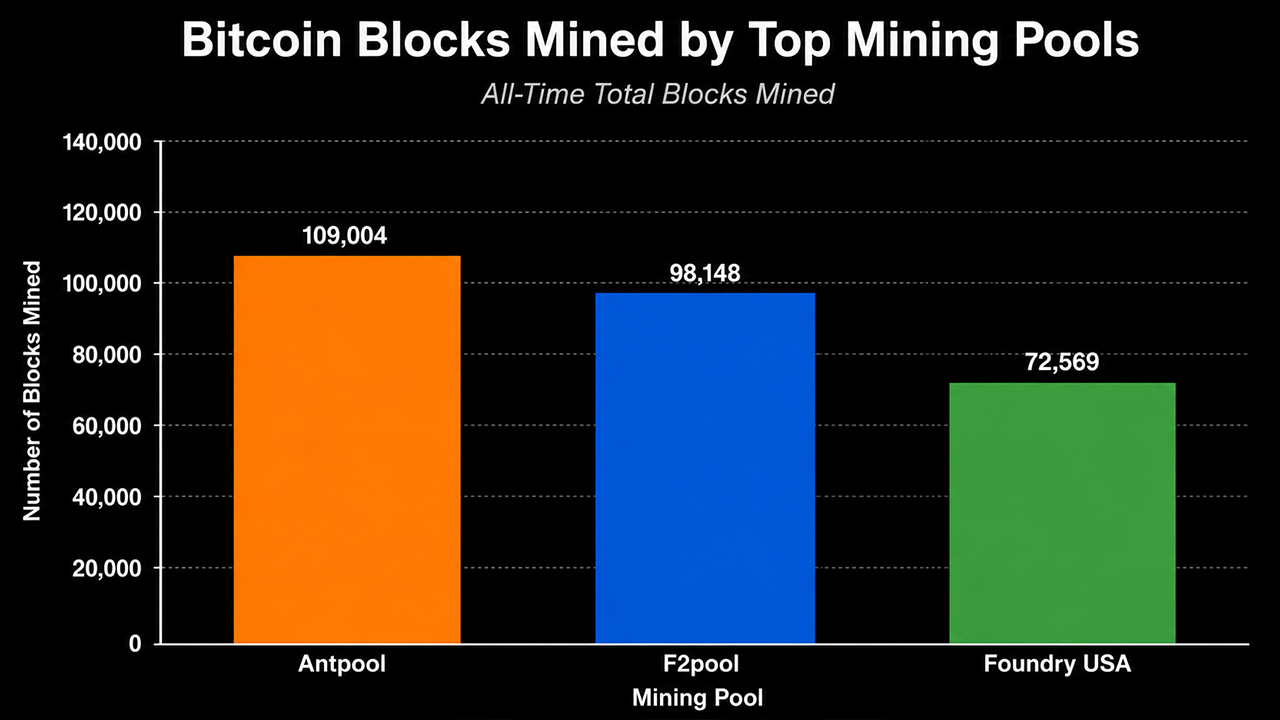
- Antpool ranks second with 109,004 blocks; Foundry USA leads current hashrate despite fewer historic blocks.
- Poolin filed Chapter 11 bankruptcy in New Jersey in July 2026 after ceasing Texas operations.
Onchain statistics tracked by Cloverpool, the mining pool and platform formerly known as btc.com, show an entity labeled “unknown” sitting atop the all-time block count with 230,770 blocks mined, equal to 24.03% of every block the network has ever produced.
That figure places the unknown category ahead of every named pool operating today, including industry leaders Antpool and F2pool. The unknown label, however, does not point to a single company or person. It covers two distinct groups of miners.
Two Kinds of Unknown Miners
The first group includes solo miners and small operations that never inserted an identifying tag into the coinbase message, the small data field miners can use to sign their blocks. Some pools and individual miners have historically left that field blank or filled it with generic text, leaving the block unattributed in explorer data.
The second group covers the Bitcoin network’s earliest years, before pooled mining existed in any organized form. That era includes the blocks mined by Bitcoin’s pseudonymous creator, Satoshi Nakamoto, who mined largely alone on a home computer in 2009 and early 2010. Researchers have long estimated Nakamoto’s own holdings near one million BTC, a figure drawn from patterns in early block rewards that remain untouched to this day.
Antpool and F2pool Round Out the Top Three
Behind the unknown category, Antpool ranks second with 109,004 blocks, or 11.35% of the total. The pool, once operated by Bitmain, the ASIC manufacturer founded by Jihan Wu and Micree Zhan, launched in 2013 and 2014 to support the company’s Antminer hardware customers. Antpool was established as a standalone entity operating independently overseas in 2021.
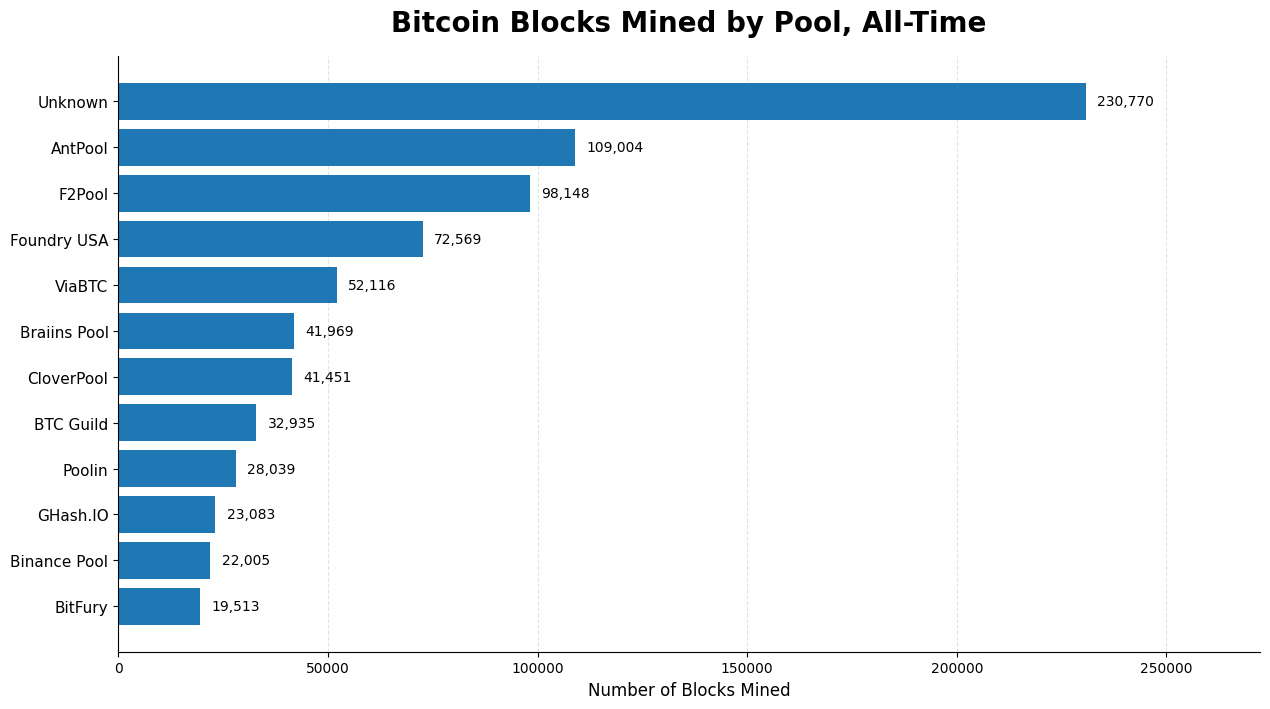
F2pool sits in third place with 98,148 blocks mined, about 10.22% of all blocks discovered. Founded in May 2013 by Chun Wang and Mao Shixing, F2pool is widely regarded as China’s oldest major public bitcoin pool and briefly controlled between 25% and 30% of network hashrate after overtaking Ghash.IO in 2014.
Foundry USA and the Post-China Shift
Foundry USA, the Digital Currency Group (DCG) subsidiary that now leads the network by current hashrate share, ranks fourth on the all-time block list with 72,569 blocks, or 7.56%. The bitcoin mining pool launched quietly in late 2020 and expanded rapidly after China’s 2021 mining crackdown pushed hashrate toward North America. Foundry now serves publicly traded miners, and typically commands more than a quarter of the live network hashrate, even though its block total trails older pools because of its later start.
Older Pools Hold Historical Weight
ViaBTC, founded by former Tencent engineer Haipo Yang in 2016, has mined 52,116 blocks, 5.43% of the total. Braiins Pool, formerly known as Slushpool, the world’s oldest continuously operating public pool, dates to November 2010 under founder Marek Palatinus and has produced 41,969 blocks, 4.37% of all blocks found.
Two defunct pools still carry meaningful weight in the historical count. BTC Guild, shut down in 2015 amid regulatory concerns and rising competition, mined 32,935 blocks, 3.43% of the total, during its run from 2011 to 2015. Ghash.IO briefly exceeded 50% of network hashrate in June 2014, an event that triggered widespread concern over a possible 51% attack, before winding down mining operations entirely in October 2016. It holds 23,083 blocks, or 2.40%.
Poolin’s Bankruptcy Adds Context
Poolin, once the world’s largest pool by September 2019, has mined 28,039 blocks, 2.92% of the total. The pool’s wallet arm suspended withdrawals in September 2022 and issued IOUs to roughly 11,700 customers totaling about $163.7 million. In July 2026, Poolin Technology and its U.S. affiliates filed for Chapter 11 bankruptcy protection in New Jersey after ceasing operations at its West Texas sites, with the filing centered on a $52 million stalking-horse bid for those properties.
Cloverpool itself, the rebranded form of BTC.com since September 2024, has mined 41,451 blocks, 2.35% of the total. Binance Pool, launched in April 2020, holds 22,005 blocks, 2.29%. Bitfury, better known today for its shift toward AI and high-performance computing, holds 19,513 blocks, 2.03%.
Why the Numbers Matter
The concentration of blocks in the unknown category is a reminder that Bitcoin’s earliest history remains only partly documented. Coinbase message attribution depends entirely on miners choosing to identify themselves, and no protocol rule requires it. For researchers studying wealth concentration, dormant wallet activity, and the scale of Nakamoto’s own holdings, the unknown block count is the closest available proxy for that unresolved history.
For the wider mining industry, the current top four pools by live hashrate, Foundry, Antpool, F2pool, and ViaBTC, together control the large majority of new blocks, producing a Nakamoto coefficient near three. That concentration, paired with the historical record of Ghash.IO’s near-majority run in 2014 and Poolin’s collapse, continues to shape how regulators, institutional miners, and crypto’s broader community weigh the risks of pooled hashrate.



